
Saga Pattern Orchestration: o maestro que nunca falha nas transações distribuídas
Imagine que você está processando um pedido de R$ 3.500,00 no seu e-commerce e o pagamento foi aprovado, mas o serviço de confirmação do pedido caiu. Resultado sem Orchestration Saga: cliente foi cobrado, mas o pedido não existe no sistema. Resultado COM Orchestration Saga: sistema automaticamente detecta a falha, estorna o pagamento e notifica o cliente - tudo sem intervenção manual.
Este é o poder do Saga Pattern Orchestration- um maestro inteligente que coordena transações distribuídas e nunca deixa seu sistema em estado inconsistente.
Demonstração rápida: veja o maestro funcionando
Antes de mergulhar na teoria, vamos ver um Orchestration Saga resolvendo o problema real:
public class OrderProcessingSaga : SagaBase
{
    protected override void InitializeSteps()
    {
        Steps.Add(new ReserveInventoryStep());    // Passo 1: Reservar estoque
        Steps.Add(new ProcessPaymentStep());      // Passo 2: Processar pagamento
        Steps.Add(new ConfirmOrderStep());        // Passo 3: Confirmar pedido
        Steps.Add(new NotifyCustomerStep());      // Passo 4: Notificar cliente
    }
}

[HttpPost]
public async Task<IActionResult> CreateOrder(CreateOrderRequest request)
{
    var saga = new OrderProcessingSaga();
    var result = await saga.StartAsync(request);

    if (result.IsSuccess)
    {
        return Ok(new { OrderId = result.OrderId });
    }
    else
    {
        return BadRequest(new { Error = result.ErrorMessage });
        // Sistema já fez rollback automático de tudo!
    }
}
O que acontece por baixo dos panos:
- Orchestrator central coordena todos os steps sequencialmente
- Se qualquer step falhar, todos os anteriores são automaticamente compensados
- Se step 3 falhar → system estorna pagamento (step 2) e libera estoque (step 1)
- Estado é persistido a cada step para garantir recuperação
- Zero código de rollback manual necessário
O que é Saga Pattern Orchestration?
Saga Orchestration é um padrão onde um coordenador central(o Orchestrator) gerencia toda a sequência de operações distribuídas, garantindo que se algo falhar, tudo seja compensado automaticamente.
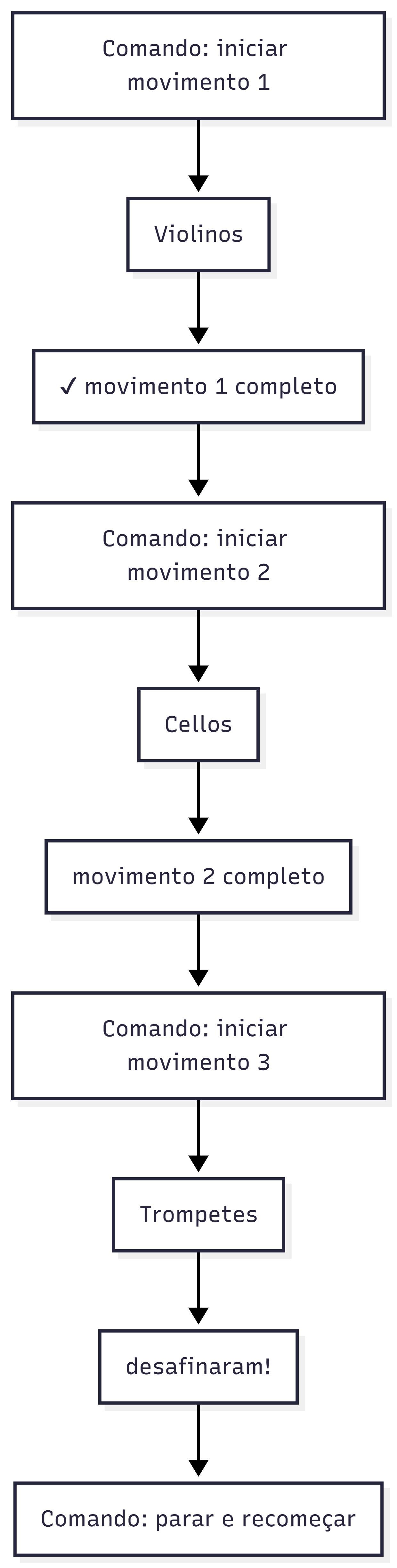
A analogia do maestro de orquestra
Imagine uma orquestra sinfônica tocando uma peça complexa:
MAESTRO (Orchestrator)
O que o maestro faz quando algo dá errado:
- Para a música imediatamente
- Instrui cada seção a voltar ao estado inicial
- Recomeça do início ou cancela a apresentação
No Saga Orchestration é exatamente igual:
- Para a saga imediatamente quando step falha
- Executa compensação de todos os steps já executados
- Marca saga como falhada com estado consistente
Por que Orchestration vs outras abordagens?
Problema sem coordenação: Código frágil e perigoso
public async Task ProcessOrder(OrderRequest request)
{
    await _inventoryService.ReserveStock(request.Items);     // Service A
    await _paymentService.ProcessPayment(request.Amount);    // Service B
    await _orderService.ConfirmOrder(request.OrderId);       // Service C

    // Se Service C falhar → A e B ficam inconsistentes!
    // Precisa de código manual para desfazer A e B
}
Solução com Orchestration: Orquestração inteligente e segura
public class OrderProcessingSaga : SagaBase
{
    protected override void InitializeSteps()
    {
        Steps.Add(new ReserveInventoryStep());    // Compensation: ReleaseInventory
        Steps.Add(new ProcessPaymentStep());      // Compensation: RefundPayment
        Steps.Add(new ConfirmOrderStep());        // Compensation: CancelOrder
    }

    // Orchestrator automaticamente executa compensação na ordem reversa
    // Se qualquer step falhar → rollback automático e estado consistente
}
Implementação
Vamos construir um Saga Orchestration:
1. Base class do Orchestrator
public abstract class SagaBase
{
    public Guid SagaId { get; } = Guid.NewGuid();
    public EnumSagaStatus Status { get; private set; } = EnumSagaStatus.Running;
    public List<ISagaStep> Steps { get; } = new();
    public List<SagaStepHistory> StepHistory { get; } = new();

    private readonly ISagaRepository _sagaRepository;
    private readonly ISagaMetrics _sagaMetrics;
    private readonly ILogger<SagaBase> _logger;

    protected abstract void InitializeSteps();

    public async Task<SagaResult> StartAsync(CancellationToken cancellationToken = default)
    {
        var stopwatch = Stopwatch.StartNew();

        try
        {
            _sagaMetrics.RecordSagaStarted(GetType().Name);
            _logger.LogInformation("Starting saga {SagaId} of type {SagaType}", SagaId, GetType().Name);

            InitializeSteps();

            // Persistir estado inicial
            await _sagaRepository.SaveAsync(GetSagaState());

            foreach (var step in Steps)
            {
                var stepResult = await ExecuteStepWithRetryAsync(step, cancellationToken);

                if (!stepResult.IsSuccess)
                {
                    _logger.LogWarning("Step {StepName} failed for saga {SagaId}: {Error}",
                        step.StepName, SagaId, stepResult.ErrorMessage);

                    await CompensateAsync();
                    return SagaResult.Failed(stepResult.ErrorMessage);
                }

                // Atualizar estado após cada step
                RecordStepSuccess(step, stepResult);
                await _sagaRepository.UpdateAsync(GetSagaState());
            }

            Status = EnumSagaStatus.Completed;
            await _sagaRepository.UpdateAsync(GetSagaState());

            stopwatch.Stop();
            _sagaMetrics.RecordSagaCompleted(GetType().Name, Status, stopwatch.Elapsed);

            _logger.LogInformation("Saga {SagaId} completed successfully in {Duration}ms",
                SagaId, stopwatch.ElapsedMilliseconds);

            return SagaResult.Success();
        }
        catch (Exception ex)
        {
            _logger.LogError(ex, "Saga {SagaId} failed with exception", SagaId);
            await CompensateAsync();

            stopwatch.Stop();
            _sagaMetrics.RecordSagaCompleted(GetType().Name, EnumSagaStatus.Failed, stopwatch.Elapsed);

            return SagaResult.Failed(ex.Message);
        }
    }

    private async Task<StepResult> ExecuteStepWithRetryAsync(ISagaStep step, CancellationToken cancellationToken)
    {
        var retryPolicy = Policy
            .Handle<Exception>(ex => IsRetryableException(ex))
            .WaitAndRetryAsync(
                retryCount: 3,
                sleepDurationProvider: retryAttempt => TimeSpan.FromSeconds(Math.Pow(2, retryAttempt)),
                onRetry: (outcome, timespan, retryCount, context) =>
                {
                    _logger.LogWarning("Retrying step {StepName} (attempt {RetryCount}) after {Delay}ms",
                        step.StepName, retryCount, timespan.TotalMilliseconds);
                });

        return await retryPolicy.ExecuteAsync(async () =>
        {
            using var timeoutCts = new CancellationTokenSource(step.Timeout);
            using var combinedCts = CancellationTokenSource.CreateLinkedTokenSource(
                cancellationToken, timeoutCts.Token);

            var command = BuildCommandForStep(step);
            return await step.ExecuteAsync(command, combinedCts.Token);
        });
    }

    private async Task CompensateAsync()
    {
        Status = EnumSagaStatus.CompensationRequired;
        await _sagaRepository.UpdateAsync(GetSagaState());

        _logger.LogWarning("Starting compensation for saga {SagaId}", SagaId);

        // Compensar na ordem REVERSA (último executado primeiro)
        var executedSteps = StepHistory
            .Where(h => h.Status == EnumSagaStatus.Completed)
            .OrderByDescending(h => h.ExecutedAt)
            .ToList();

        var compensationFailures = new List<string>();

        foreach (var stepHistory in executedSteps)
        {
            try
            {
                var step = Steps.First(s => s.StepName == stepHistory.StepName);
                var command = GetCommandForStep(step);

                _logger.LogInformation("Compensating step {StepName} for saga {SagaId}",
                    step.StepName, SagaId);

                await step.CompensateAsync(command);

                RecordStepCompensated(step);
            }
            catch (Exception ex)
            {
                _logger.LogError(ex, "Failed to compensate step {StepName} for saga {SagaId}",
                    stepHistory.StepName, SagaId);

                compensationFailures.Add($"{stepHistory.StepName}: {ex.Message}");
                RecordStepCompensationFailed(stepHistory.StepName, ex.Message);

                // Alertar operações para intervenção manual
                await _alertingService.SendCriticalAlertAsync(
                    $"Compensation failed for step {stepHistory.StepName} in saga {SagaId}");
            }
        }

        if (compensationFailures.Any())
        {
            Status = EnumSagaStatus.CompensationFailed;
            await _sagaRepository.UpdateAsync(GetSagaState());

            throw new CompensationException($"Failed to compensate: {string.Join(", ", compensationFailures)}");
        }
        else
        {
            Status = EnumSagaStatus.Compensated;
            await _sagaRepository.UpdateAsync(GetSagaState());

            _logger.LogInformation("Successfully compensated saga {SagaId}", SagaId);
        }
    }
}

public enum EnumSagaStatus
{
    Running,
    Completed,
    Failed,
    CompensationRequired,
    Compensated,
    CompensationFailed
}
2. Interface e base para Steps
public interface ISagaStep
{
    string StepName { get; }
    TimeSpan Timeout { get; }
    Task<StepResult> ExecuteAsync(object command, CancellationToken cancellationToken = default);
    Task CompensateAsync(object command, CancellationToken cancellationToken = default);
}

public abstract class SagaStepBase<TCommand, TResponse> : ISagaStep
{
    protected readonly ILogger<SagaStepBase<TCommand, TResponse>> _logger;

    public abstract string StepName { get; }
    public abstract TimeSpan Timeout { get; }

    public abstract Task<TResponse> ExecuteAsync(TCommand command, CancellationToken cancellationToken = default);
    public abstract Task CompensateAsync(TCommand command, CancellationToken cancellationToken = default);

    public async Task<StepResult> ExecuteAsync(object command, CancellationToken cancellationToken = default)
    {
        if (command is not TCommand typedCommand)
        {
            throw new ArgumentException($"Expected {typeof(TCommand).Name} but got {command.GetType().Name}");
        }

        try
        {
            var result = await ExecuteAsync(typedCommand, cancellationToken);
            return StepResult.Success(result);
        }
        catch (Exception ex) when (IsBusinessException(ex))
        {
            return StepResult.Failed(ex.Message, isRetryable: false);
        }
        catch (Exception ex)
        {
            return StepResult.Failed(ex.Message, isRetryable: true);
        }
    }

    public async Task CompensateAsync(object command, CancellationToken cancellationToken = default)
    {
        if (command is not TCommand typedCommand)
        {
            throw new ArgumentException($"Expected {typeof(TCommand).Name} but got {command.GetType().Name}");
        }

        await CompensateAsync(typedCommand, cancellationToken);
    }

    protected virtual bool IsBusinessException(Exception ex)
    {
        return ex is BusinessLogicException || ex is ValidationException;
    }
}

public class StepResult
{
    public bool IsSuccess { get; private set; }
    public string ErrorMessage { get; private set; } = string.Empty;
    public bool IsRetryable { get; private set; }
    public object? Data { get; private set; }

    public static StepResult Success(object? data = null) => new() { IsSuccess = true, Data = data };
    public static StepResult Failed(string error, bool isRetryable = true) => new()
    {
        IsSuccess = false,
        ErrorMessage = error,
        IsRetryable = isRetryable
    };
}
3. Step concreto: Reservar estoque
public class ReserveInventoryStep : SagaStepBase<ReserveInventoryCommand, InventoryReservedResponse>
{
    private readonly IInventoryService _inventoryService;

    public override string StepName => "ReserveInventory";
    public override TimeSpan Timeout => TimeSpan.FromSeconds(30);

    public override async Task<InventoryReservedResponse> ExecuteAsync(
        ReserveInventoryCommand command,
        CancellationToken cancellationToken = default)
    {
        _logger.LogInformation("Reserving inventory for order {OrderId} with {ItemCount} items",
            command.OrderId, command.Items.Count);

        var reservationIds = new List<Guid>();

        foreach (var item in command.Items)
        {
            // Verificar disponibilidade primeiro (operação idempotente)
            var availability = await _inventoryService.CheckAvailabilityAsync(
                item.ProductId, item.Quantity, cancellationToken);

            if (!availability.IsAvailable)
            {
                _logger.LogWarning("Insufficient stock for product {ProductId}. Available: {Available}, Requested: {Requested}",
                    item.ProductId, availability.AvailableQuantity, item.Quantity);

                throw new InsufficientStockException(
                    $"Product {item.ProductId} has only {availability.AvailableQuantity} units available, but {item.Quantity} were requested");
            }

            // Reservar estoque (operação atômica)
            var reservation = await _inventoryService.ReserveAsync(
                item.ProductId, item.Quantity, command.OrderId, cancellationToken);

            reservationIds.Add(reservation.Id);

            _logger.LogInformation("Reserved {Quantity} units of product {ProductId} with reservation {ReservationId}",
                item.Quantity, item.ProductId, reservation.Id);
        }

        var response = new InventoryReservedResponse
        {
            OrderId = command.OrderId,
            ReservationIds = reservationIds,
            ExpiresAt = DateTime.UtcNow.AddMinutes(15), // TTL para limpeza automática
            TotalItemsReserved = command.Items.Sum(i => i.Quantity)
        };

        _logger.LogInformation("Successfully reserved inventory for order {OrderId}. Reservations: {ReservationIds}",
            command.OrderId, string.Join(", ", reservationIds));

        return response;
    }

    public override async Task CompensateAsync(
        ReserveInventoryCommand command,
        CancellationToken cancellationToken = default)
    {
        _logger.LogInformation("Compensating inventory reservation for order {OrderId}", command.OrderId);

        try
        {
            // Buscar todas as reservas feitas para este pedido
            var reservations = await _inventoryService.GetReservationsByOrderAsync(
                command.OrderId, cancellationToken);

            if (!reservations.Any())
            {
                _logger.LogInformation("No reservations found for order {OrderId}. Compensation not needed.",
                    command.OrderId);
                return;
            }

            foreach (var reservation in reservations)
            {
                // Operação idempotente - se já foi liberada, não faz nada
                await _inventoryService.ReleaseReservationAsync(reservation.Id, cancellationToken);

                _logger.LogInformation("Released reservation {ReservationId} for product {ProductId} (quantity: {Quantity})",
                    reservation.Id, reservation.ProductId, reservation.Quantity);
            }

            _logger.LogInformation("Successfully compensated inventory reservation for order {OrderId}. Released {Count} reservations.",
                command.OrderId, reservations.Count());
        }
        catch (Exception ex)
        {
            _logger.LogError(ex, "Failed to compensate inventory reservation for order {OrderId}. Manual intervention required!",
                command.OrderId);

            // Escalar para operações
            await _alertingService.SendCriticalAlertAsync(
                $"Failed to release inventory reservation for order {command.OrderId}. Manual cleanup required!");

            throw; // Re-throw para marcar compensação como falhada
        }
    }
}
Command e Response models
public record ReserveInventoryCommand
{
    public Guid OrderId { get; init; }
    public List<OrderItem> Items { get; init; } = new();
    public DateTime RequestedAt { get; init; } = DateTime.UtcNow;
}

public record InventoryReservedResponse
{
    public Guid OrderId { get; init; }
    public List<Guid> ReservationIds { get; init; } = new();
    public DateTime ExpiresAt { get; init; }
    public int TotalItemsReserved { get; init; }
}

public record OrderItem
{
    public Guid ProductId { get; init; }
    public int Quantity { get; init; }
    public decimal UnitPrice { get; init; }
}
4. Step de pagamento com retry inteligente
public class ProcessPaymentStep : SagaStepBase<ProcessPaymentCommand, PaymentProcessedResponse>
{
    private readonly IPaymentGateway _paymentGateway;

    public override string StepName => "ProcessPayment";
    public override TimeSpan Timeout => TimeSpan.FromMinutes(2); // Payments podem demorar

    public override async Task<PaymentProcessedResponse> ExecuteAsync(
        ProcessPaymentCommand command,
        CancellationToken cancellationToken = default)
    {
        _logger.LogInformation("Processing payment for order {OrderId} amount {Amount} {Currency}",
            command.OrderId, command.Amount, command.Currency);

        // Verificar se pagamento já foi processado (idempotência)
        var existingTransaction = await _paymentGateway.GetTransactionByOrderIdAsync(
            command.OrderId, cancellationToken);

        if (existingTransaction != null)
        {
            _logger.LogInformation("Payment already processed for order {OrderId}. Transaction: {TransactionId}",
                command.OrderId, existingTransaction.TransactionId);

            return new PaymentProcessedResponse
            {
                OrderId = command.OrderId,
                TransactionId = existingTransaction.TransactionId,
                Amount = existingTransaction.Amount,
                Currency = existingTransaction.Currency,
                ProcessedAt = existingTransaction.ProcessedAt,
                Status = existingTransaction.Status
            };
        }

        // Processar pagamento com retry para falhas transitórias
        var paymentRequest = new PaymentRequest
        {
            OrderId = command.OrderId,
            Amount = command.Amount,
            Currency = command.Currency,
            PaymentMethod = command.PaymentMethod,
            CardToken = command.CardToken,
            IdempotencyKey = $"order-{command.OrderId}-{DateTime.UtcNow:yyyyMMdd}" // Chave de idempotência
        };

        var paymentResult = await _paymentGateway.ProcessPaymentAsync(paymentRequest, cancellationToken);

        switch (paymentResult.Status)
        {
            case PaymentStatus.Approved:
                _logger.LogInformation("Payment approved for order {OrderId}. TransactionId: {TransactionId}",
                    command.OrderId, paymentResult.TransactionId);

                return new PaymentProcessedResponse
                {
                    OrderId = command.OrderId,
                    TransactionId = paymentResult.TransactionId,
                    Amount = paymentResult.Amount,
                    Currency = paymentResult.Currency,
                    ProcessedAt = paymentResult.ProcessedAt,
                    Status = PaymentStatus.Approved
                };

            case PaymentStatus.Declined:
                _logger.LogWarning("Payment declined for order {OrderId}. Reason: {Reason}",
                    command.OrderId, paymentResult.DeclineReason);

                throw new PaymentDeclinedException(paymentResult.DeclineReason ?? "Payment was declined");

            case PaymentStatus.Pending:
                _logger.LogInformation("Payment is pending for order {OrderId}. Will retry...", command.OrderId);
                throw new PaymentPendingException("Payment is still being processed");

            default:
                throw new PaymentProcessingException($"Unexpected payment status: {paymentResult.Status}");
        }
    }

    public override async Task CompensateAsync(
        ProcessPaymentCommand command,
        CancellationToken cancellationToken = default)
    {
        _logger.LogInformation("Compensating payment for order {OrderId}", command.OrderId);

        try
        {
            // Buscar transação original
            var transaction = await _paymentGateway.GetTransactionByOrderIdAsync(
                command.OrderId, cancellationToken);

            if (transaction == null)
            {
                _logger.LogInformation("No payment transaction found for order {OrderId}. Compensation not needed.",
                    command.OrderId);
                return;
            }

            if (transaction.Status != PaymentStatus.Approved)
            {
                _logger.LogInformation("Payment for order {OrderId} was not approved (status: {Status}). No refund needed.",
                    command.OrderId, transaction.Status);
                return;
            }

            // Verificar se refund já foi processado
            var existingRefund = await _paymentGateway.GetRefundByTransactionIdAsync(
                transaction.TransactionId, cancellationToken);

            if (existingRefund != null)
            {
                _logger.LogInformation("Refund already processed for transaction {TransactionId}. RefundId: {RefundId}",
                    transaction.TransactionId, existingRefund.RefundId);
                return;
            }

            // Processar refund
            var refundRequest = new RefundRequest
            {
                OriginalTransactionId = transaction.TransactionId,
                Amount = transaction.Amount,
                Reason = "Order cancelled due to saga failure",
                IdempotencyKey = $"refund-{transaction.TransactionId}-{DateTime.UtcNow:yyyyMMdd}"
            };

            var refundResult = await _paymentGateway.RefundAsync(refundRequest, cancellationToken);

            if (refundResult.Status == RefundStatus.Approved)
            {
                _logger.LogInformation("Successfully refunded payment for order {OrderId}. RefundId: {RefundId}",
                    command.OrderId, refundResult.RefundId);
            }
            else
            {
                _logger.LogError("Failed to refund payment for order {OrderId}. Status: {Status}, Reason: {Reason}",
                    command.OrderId, refundResult.Status, refundResult.DeclineReason);

                throw new RefundFailedException(
                    $"Refund failed with status {refundResult.Status}: {refundResult.DeclineReason}");
            }
        }
        catch (Exception ex)
        {
            _logger.LogError(ex, "Failed to compensate payment for order {OrderId}. Manual refund required!",
                command.OrderId);

            // Escalar para operações financeiras
            await _alertingService.SendCriticalAlertAsync(
                $"Failed to refund payment for order {command.OrderId}. Manual refund required! Exception: {ex.Message}");

            throw; // Critical: payment compensation must succeed
        }
    }
}
Vantagens do Orchestration Saga
Benefícios principais:
1. Controle centralizado
- Debugging simplificado: Todo fluxo visível em um lugar
- Lógica de negócio clara: Sequência de steps bem definida
- Monitoramento fácil: Estado centralizado para observar
2. Tratamento de falhas robusto
- Compensação automática: Rollback na ordem correta
- Retry inteligente: Diferencia falhas transitórias vs permanentes
- Estado persistido: Recuperação após restart da aplicação
3. Testabilidade
- Steps isolados: Cada step pode ser testado independentemente
- Mock fácil: Substituir dependencies dos steps em testes
- Cenários de falha: Simular falhas em qualquer step
4. Evolução controlada
- Versionamento: Adicionar/remover steps sem quebrar sagas em andamento
- A/B testing: Diferentes implementações de steps
- Rollback seguro: Voltar versão anterior sem perder sagas ativas
Armadilhas do Orchestration e como evitá-las
Problemas comuns:
1. Orchestrator como bottleneck
PERIGOSO- todos os pedidos passam pelo mesmo orchestrator
Vai virar gargalo com alto volume!
public class SingletonOrderOrchestrator
{
    private static readonly OrderOrchestrator _instance = new();
}
Solução:
SEGURO- instância por saga Nova instância para cada pedido
public class OrdersController : ControllerBase
{
    [HttpPost]
    public async Task<IActionResult> CreateOrder(CreateOrderRequest request)
    {
        var saga = new OrderProcessingSaga(_serviceProvider);
        var result = await saga.StartAsync(request);

        return result.IsSuccess ? Ok(result) : BadRequest(result);
    }
}
2. Steps muito grandes e acoplados
PERIGOSO- step faz muita coisa
public class ProcessOrderStep : SagaStepBase<ProcessOrderCommand, ProcessOrderResponse>
{
    public override async Task<ProcessOrderResponse> ExecuteAsync(ProcessOrderCommand command)
    {
        // Fazendo tudo em um step
        await ValidateCustomer(command.CustomerId);
        await ReserveInventory(command.Items);
        await ProcessPayment(command.Amount);
        await GenerateInvoice(command.OrderId);
        await SendEmail(command.CustomerEmail);

        // Se qualquer coisa falhar, perde todo o trabalho!
    }
}
Solução:
// SEGURO - steps granulares
public class OrderProcessingSaga : SagaBase
{
    protected override void InitializeSteps()
    {
        Steps.Add(new ValidateCustomerStep());     // Step 1: rápido e simples
        Steps.Add(new ReserveInventoryStep());     // Step 2: pode falhar por estoque
        Steps.Add(new ProcessPaymentStep());       // Step 3: pode falhar por cartão
        Steps.Add(new GenerateInvoiceStep());      // Step 4: raramente falha
        Steps.Add(new SendEmailStep());           // Step 5: não crítico
    }
}
3. Não implementar timeouts
PERIGOSO- pode travar para sempre Se gateway travar, saga trava para sempre
public override async Task<PaymentResponse> ExecuteAsync(PaymentCommand command)
{
    return await _paymentGateway.ProcessAsync(command);
}
Solução:
SEGURO- timeout em todos os steps
public override TimeSpan Timeout => TimeSpan.FromMinutes(2);

public override async Task<PaymentResponse> ExecuteAsync(
    PaymentCommand command,
    CancellationToken cancellationToken)
{
    using var timeoutCts = new CancellationTokenSource(Timeout);
    using var combinedCts = CancellationTokenSource.CreateLinkedTokenSource(
        cancellationToken, timeoutCts.Token);

    try
    {
        return await _paymentGateway.ProcessAsync(command, combinedCts.Token);
    }
    catch (OperationCanceledException) when (timeoutCts.Token.IsCancellationRequested)
    {
        throw new StepTimeoutException($"Payment step timed out after {Timeout}");
    }
}
Quando usar Orchestration Saga
Use Orchestration quando:
1. Processo de negócio complexo e bem definido
- E-commerce order processing
- Loan approval workflows
- Insurance claims processing
- Multi-step onboarding processes
2. Debugging e auditoria são críticos
- Sistemas financeiros
- Healthcare applications
- Compliance-heavy industries
3. Controle fino sobre o fluxo é necessário
- Conditional branching baseado em resultados
- Parallel execution de alguns steps
- Dynamic step selection baseado em contexto
4. Equipe centralizada ou pequena
- Time pequeno que pode manter orchestrator
- Ownership centralizado do processo de negócio
NÃO use quando:
1. Performance extrema é necessária
- Orchestrator adiciona latência de network
- Steps sequenciais podem ser lentos
2. Serviços completamente autônomos
- Teams independentes querem controle total
- Microservices com bounded contexts bem definidos
3. Escalabilidade horizontal extrema
- Milhões de sagas simultâneas
- Orchestrator pode virar bottleneck (gargalo)
Resumo: o maestro que nunca falha
Saga Orchestration é o padrão ideal quando você precisa de controle centralizado sobre transações distribuídas complexas.
Próximo passo:
No próximo artigo, vamos explorar Saga Choreography- a abordagem descentralizada onde serviços se coordenam através de eventos, oferecendo melhor performance e escalabilidade, mas com complexidade adicional de debugging.
Próximos passos:
- Implemente os exemplos em um projeto teste
- Configure monitoramento desde o primeiro dia
- Comece com casos de uso simples antes de processos complexos
Recursos adicionais:
- Documentação oficial do .NET sobre transações distribuídas
- Enterprise Integration Patterns - Process Manager
- Microservices Patterns by Chris Richardson
Gostou do conteúdo? Conecte-se comigo no LinkedIn para mais artigos sobre arquitetura de software e desenvolvimento .NET!